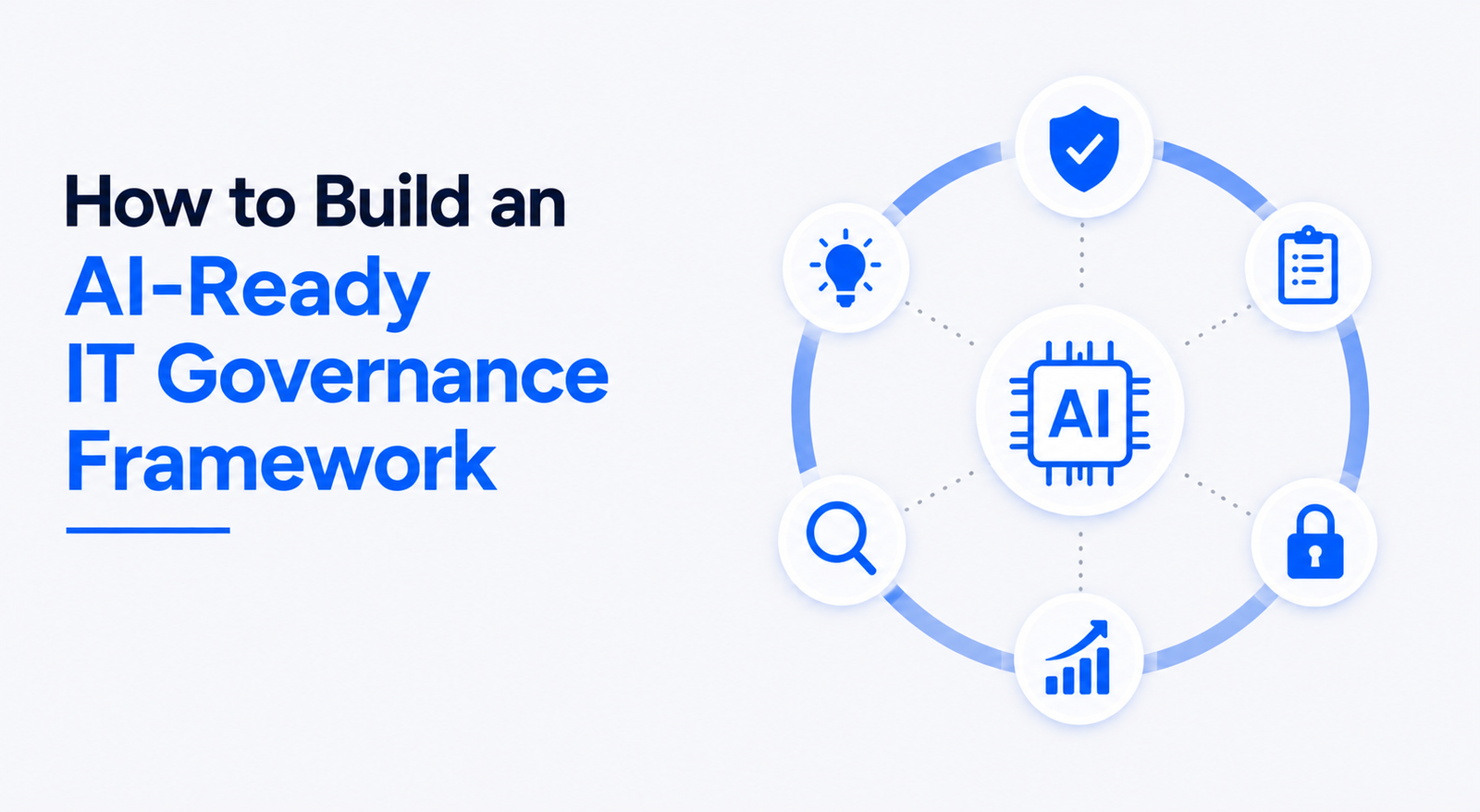
Every IT governance framework I have worked with was built for a world where a project has a scope, a budget, a delivery date, and a measurable outcome. That world still exists, but AI initiatives do not fit in it. A Gen AI pilot can clear every approval gate and still never scale because the organization was not ready for what it required. What follows is how I think about building an AI governance framework that accounts for the specific ways AI projects fail, without abandoning the discipline that makes governance credible.
1. Start with the failure modes
AI initiatives fail for reasons that IT governance has never been designed to address. Poor data readiness is the most common: an initiative that looks compelling on paper can be dead on arrival because the data it depends on does not exist in usable form. Organizational readiness is the second – AI does not just automate a task, it changes it, and approving an initiative without assessing whether the organization is ready to operate it means approving something that may technically work and practically fail. Model risk is the third: an AI model can degrade silently after deployment, and a framework with no post-deployment monitoring is governing the project and ignoring the product.
For automation initiatives, there is a fourth failure mode that rarely surfaces in governance conversations: process readiness. AI can only automate processes whose outputs can be objectively defined and measured. A process that relies on tacit judgment or undocumented exceptions is not an automation candidate. It is a documentation problem dressed up as a technology opportunity. Most organizations fund the technology without assessing the process. The result is automation projects that stall mid-delivery when the persisting ambiguity has to be finally resolved in code.
The governance question for an AI initiative is not just ‘should we fund it?’ It is ‘are we ready to run it?’ Those are different questions with different answers.
2. Classify before you score
A robotic process automation deployment and an agentic workflow are not in the same risk category. Scoring them on identical criteria is one of the most common failures in IT governance for AI. An AI-ready framework classifies initiatives by type before applying any prioritization:
- Process automation: Lowest governance complexity.
- Predictive and analytical AI: Moderate complexity.
- Generative AI: Higher complexity – output reliability and information governance require explicit attention.
- Agentic AI: Highest complexity – failure modes are harder to predict and can be difficult to reverse.
3. Score data readiness before you approve
This is the governance step most organizations skip – and the one that would prevent the largest share of failed AI pilots. Data readiness is not a question of whether the data exists. It is a question of whether it is accessible, in the right format, at the required quality, and with the ownership clarity to keep it reliably available going forward. Each of those dimensions can fail independently, and each is assessable before a dollar is committed. A mature AI governance framework treats data readiness as a formal approval criterion – scored, not checked.
4. Separate build, operate, and inference costs
Build cost covers data preparation, model development, and deployment – analogous to a project budget. Operate cost covers infrastructure and maintenance once the model is live. Inference cost is the ongoing expense of running predictions at scale – variable, usage-dependent, and frequently underestimated at approval time. Organizations that approve AI initiatives without a framework for projecting inference cost regularly discover that a pilot affordable at small scale becomes expensive in production. That budget conversation should happen before the commitment, not after it.
Build cost gets the scrutiny. Operate cost gets a line item. Inference cost gets discovered after go-live. A good AI governance framework closes that gap before it opens.
5. Extend governance beyond the approval gate
The approval gate is not the end of governance for an AI initiative – it is the beginning of the operating phase. An AI-ready framework defines success in operational terms before approval: model accuracy thresholds, adoption metrics, business outcome indicators, and the escalation trigger that determines when a model’s performance warrants a retraining decision or a funding review. The organizations that handle this well treat enterprise AI governance as a continuous process, not a planning-cycle event – and they are not waiting for the annual review to discover a model funded two years ago is no longer performing.
6. Distinguish internal AI from product AI
Internal AI improves operations – automating workflows, surfacing insights for employees. Benefits are measured in cost reduction or risk avoidance. Product AI is embedded in customer-facing offerings. Benefits are measured in engagement or revenue, and the risk profile adds reputational exposure and regulatory scrutiny. A governance framework that does not distinguish between them applies the wrong benefit tracking model, produces misleading comparisons, and misses requirements that apply to one category and not the other. Effective AI portfolio governance requires this distinction from the start.
What changes in an AI-ready framework
|
Capability Gap |
Legacy Framework |
AI-Ready Framework |
|
Risk identification |
Technical and financial risk only |
Adds model risk, data risk, and org readiness |
|
Cost classification |
CapEx vs. OpEx |
Build, operate, and inference costs tracked separately |
|
Initiative typing |
Project categories |
AI type: automation, predictive, generative, agentic |
|
Benefit validation |
Benefits entered at submission |
Data readiness scored before funding committed |
|
Governance cadence |
Annual planning cycle |
Continuous – AI models drift; governance must keep pace |
|
Success criteria |
On-time, on-budget delivery |
Model accuracy, adoption, and measurable business outcome |
None of this requires rebuilding from scratch. The fundamentals – structured intake, scored prioritization, approval workflows, benefit tracking – remain the foundation. What changes is the layer above: AI-specific criteria embedded in those processes, classification logic applied before scoring begins, and monitoring that extends governance past the approval gate. The organizations that get the most from their enterprise AI governance investments are not the ones moving fastest. They are the ones with the discipline to ask the right questions before the commitment is made – and the infrastructure to keep asking them after it is.