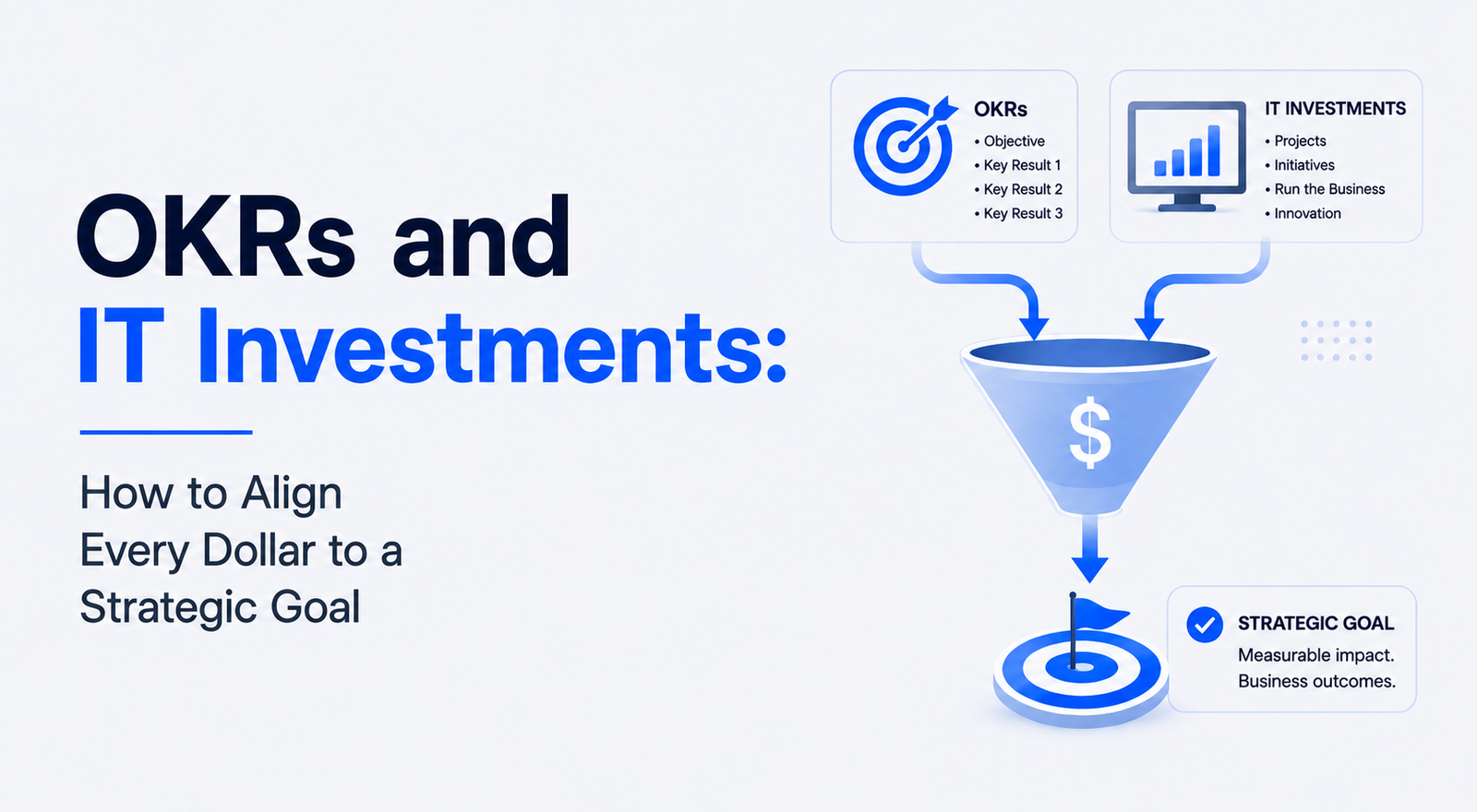

I have worked with large IT organizations whose leaders describe innovation the same way: important in principle, elusive in practice. A sound innovation strategy does not start with ideas – it starts with the conditions that let ideas survive long enough to matter. That means rethinking how you fund, govern, measure, and democratize innovation in a world where every employee now has access to AI tools.
Enabling Innovation: Mode Matters
“Start small, fail fast, scale soon” still holds. Proof-of-concepts, rapid prototyping, and hackathons are proven tools. The real challenge is that most IT organizations apply a single operating model to every kind of work – and that model is usually built for the opposite of innovation. Bureaucracy does not kill ideas outright. It exhausts them.
Effective IT strategy requires a multi-mode operating model:
- Innovation mode: Minimize gates, maximize speed. The objective is learning, not certainty.
- Customer-facing IT: Quality of user experience and deployment velocity take priority.
- Core back-office systems: Robustness, dependability, and audit readiness are non-negotiable.
Funding Innovation: Reserve the Budget Before You Need It
The most reliable way to kill an innovation agenda is to run every initiative through the standard IT investment planning process. Annual planning cycles are built for predictability. Innovation is not predictable by design. The organizations I have seen do this well set aside a dedicated innovation budget before the planning cycle begins – a ring-fenced allocation deployed against emerging opportunities without triggering a full approval workflow. Knowing the budget exists changes how people think about bringing ideas forward.
Democratizing Innovation in the Age of AI Tools
Something fundamental has shifted. When AI tools were accessible only to technical specialists, innovation was centralized – a few people with the right skills built things for everyone else. That model is over. Today, virtually every employee can prototype an idea, automate a workflow, or analyze a dataset without writing a line of code. The implication for innovation management is significant: the constraint is no longer capability. It is governance.
Democratizing innovation through AI requires a framework that addresses three things:
- Access with guardrails: Approved tools and clear usage policies. “Everyone has access” without a framework is shadow IT at scale.
- An intake channel for AI-generated ideas: When employees use AI to identify inefficiencies and build workarounds, those insights need somewhere to go. A lightweight, always-open innovation intake captures value that would otherwise evaporate.
- Structured evaluation before scaling: AI-assisted prototypes can be built in hours. A lightweight scoring framework keeps the pipeline from becoming an unmanaged backlog.
The CIOs navigating this well treat employee-generated AI initiatives as a distinct portfolio category – funded from the innovation budget, evaluated on a faster cadence, tracked separately from the core IT portfolio.
Measuring Innovation: Define the Framework Early
Innovation without measurement eventually becomes theater. Innovative product companies track what percentage of revenue comes from products launched in the last five years. IT organizations need an equivalent: benefit categories defined up front – hard-dollar savings, efficiency gains, risk reduction, strategic contribution to corporate objectives. Measure promised value against realized value, and report those results to stakeholders in a way that connects innovation investment to business outcomes, not just project activity. IT organizations that do this earn a seat at the strategic table. The ones that don’t remain a cost center.
IT Governance for Innovation: Right-Size the Rules
The most common governance mistake is uniformity – applying the same rigor to a $15,000 AI prototype as to a $15M ERP implementation. Good IT governance is not about more rules. It is about the right rules for the right initiatives:
- Seed-stage experiments: lightweight intake, fast approval, fixed spending cap, no formal business case.
- Validated prototypes ready to scale: structured IT investment planning with a full business case and a clear owner.
- Strategic programs: full portfolio governance with prioritization methodology, approval workflow, and benefit tracking.
The goal is the lowest sufficient level of governance – enough to catch real risks, not so much that ideas never get off the ground.
Creating a Culture of Innovation
Frameworks and budgets create the conditions. Culture determines whether people use them. I have always subscribed to Steve Jobs’ view that you hire smart people so they can tell you what to do, not the other way around. That philosophy is more relevant now than ever. With AI tools in everyone’s hands, the limiting factor in your innovation strategy is not talent or technology – it is whether people believe their ideas are welcome.
Recognize the people who bring ideas forward, not just the ones whose ideas succeed. Celebrate thoughtful failures. And make the feedback loop fast – when an idea is submitted and nothing happens for three months, the next idea stays unsubmitted. Innovation comes from every corner of the organization. Your job is to build an innovation management system that catches those ideas before they disappear – and an IT strategy that has a place for them to land.