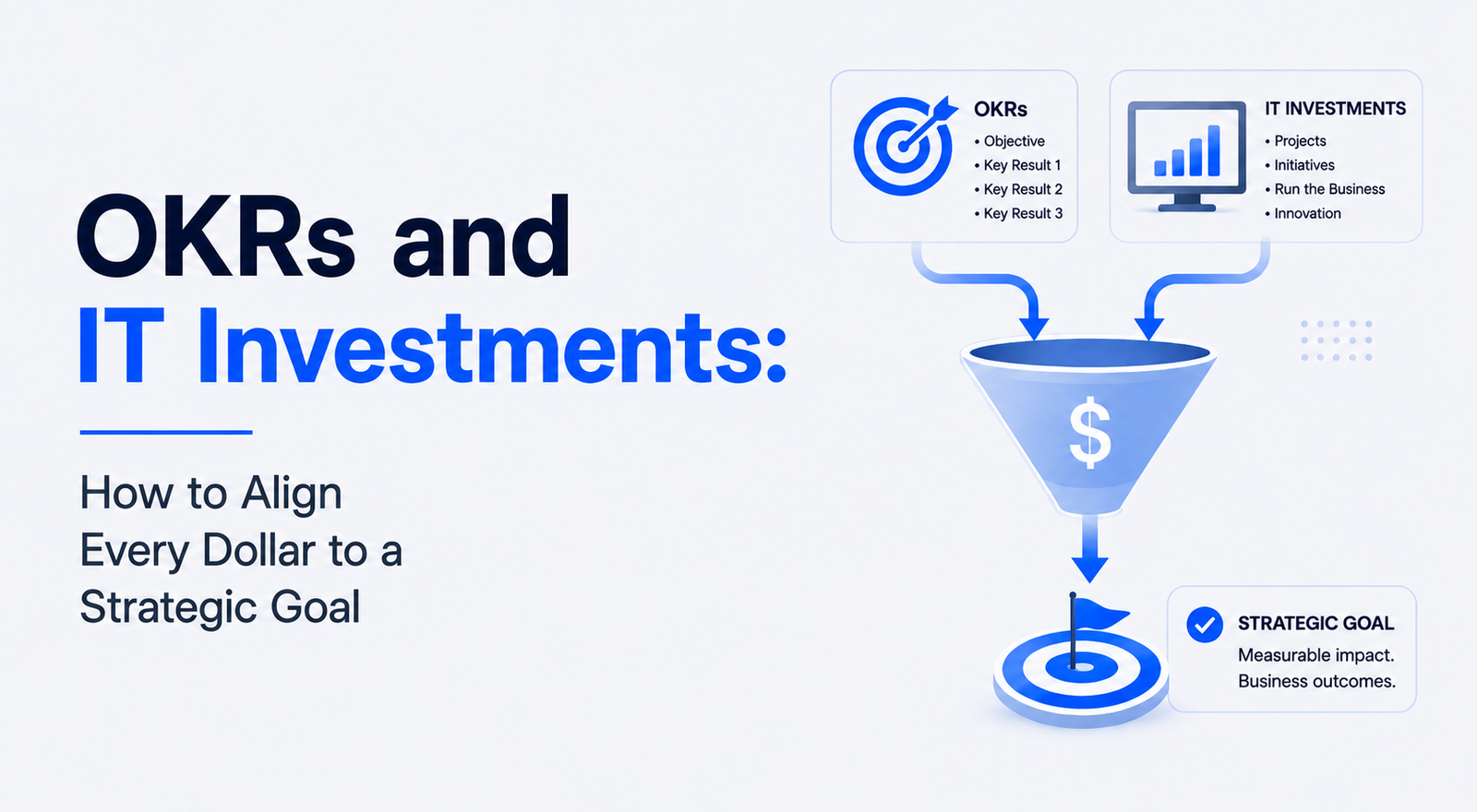
Every CIO I have worked with believes, in principle, that IT investments should align to business goals. The harder question is how. OKRs for IT teams have become one of the default answers – define the objectives, score alignment, fund what fits. In theory, it is elegant. In practice, it breaks down in three places that nobody warns you about.
Understanding where it breaks is not an argument against using OKRs. It is the argument for using them properly – as one input into IT investment alignment, not the whole framework.
The temporal problem: OKRs are for this year. IT planning is for next year.
The most underappreciated structural tension in strategic IT planning is timing. OKRs are typically set at the start of a fiscal year and maybe… revised quarterly. IT investment planning happens before the fiscal year begins and often times, months before the OKRs that should guide it have been finalized.
You cannot align technology spend alignment to objectives that do not yet exist. And in organizations where OKRs change meaningfully each year, an investment portfolio built around last year’s priorities may be funding answers to questions the business has stopped asking.
The fix is to treat IT investment planning as a dynamic process rather than an annual exercise. Plans should be live enough to be updated as strategic context changes. When new OKRs land, the portfolio should be re-aligned, re-prioritized and funding shifted as needed. Organizations that treat the approved plan as a sealed document lose this ability entirely.
When OKRs shift dramatically mid-cycle, the worst outcome is a portfolio that stays perfectly aligned to last year’s strategy. The second worst is a portfolio that has no structured way to respond at all.
The translation problem: not every OKR has an IT investment behind it.
OKRs are written by the business, not by IT, and not all of them translate to funded technology initiatives. An objective to improve employee engagement, strengthen customer relationships, or deepen partnerships with suppliers may generate very few IT investment decisions, if any.
Forcing every IT initiative to demonstrate OKR alignment produces one of two outcomes. Either teams stretch their justifications to find a connection, and the Strategic Alignment Index stops measuring actual alignment and starts measuring creative writing. Or genuinely important initiatives that are harder to link to a headline objective – security patching, technical debt reduction, infrastructure stability, get scored punitively and deprioritized.
The answer is not to mandate alignment where none exists, but to build a framework that is honest about what OKR alignment can and cannot see. Compliance initiatives belong in a risk reduction lens. Infrastructure investments belong in a financial and operational lens. Strategic bets belong in the OKR lens. A mature IT budget to business goals framework uses multiple methodologies and applies each where it is actually appropriate.
The coverage problem: not every IT priority can be mapped to an OKR.
The flip side is equally true. Some of the most important investments IT makes are not visible in the OKR structure at all, and should not be. Keeping the lights on, managing technical risk, replacing end-of-life systems: none of these appears as a strategic objective. All of them absorb significant budget.
An IT investment alignment framework that relies solely on OKRs will systematically undervalue the investments that keep the organization running and overvalue the ones with the most compelling strategic narrative. Over time, this erodes the portfolio’s credibility, particularly with finance leaders who know that the strategic alignment story does not add up to the actual spend.
A more honest approach is to segment the portfolio before scoring it. Strategic programs earn their place through OKR alignment. Regulatory and compliance initiatives earn theirs through a risk and urgency framework. Infrastructure and operational continuity investments earn theirs through financial impact and technical necessity. Trying to express all three through a single OKR lens produces a distorted picture of the portfolio.
What actually works: OKRs as one lens, not the only one.
The organizations I have seen do technology spend alignment well share a common approach. They use OKR-based scoring – a Strategic Alignment Index tied to defined themes and objectives – as their primary lens for discretionary strategic investment. And they pair it with a secondary methodology that captures what OKR alignment alone cannot: business value, urgency, risk, and financial return.
This gives the steering committee a two-dimensional view. Does this initiative align to where we said we were going? And what does it cost us not to do it? Those two questions, answered together, produce better decisions than either question alone. A high OKR score with no urgency signal is a strategically aligned initiative that can wait. A high urgency score with low OKR alignment is a risk that needs to be funded regardless of this year’s objectives.
The practical mechanics matter too. OKR themes should be defined before the investment submission window opens – not after it closes. Weights should reflect actual strategic priorities, not compromise between competing sponsors. Justifications for high alignment scores should be required, so that a score of 9 or 10 demands an explanation, not just a selection. And the portfolio’s alignment profile should be visible in real time, not reconstructed for a steering committee readout after the fact.
The goal is a defensible portfolio, not a perfectly aligned one.
Technology spend alignment is not the same as strategic conformity. The best IT portfolios I have seen are not the ones where every initiative traces neatly to a headline objective. They are the ones where every investment – strategic or operational, discretionary or required – can be explained, challenged, and defended on its own terms.
OKRs give you the strategic signal. Financial return gives you the economic signal. Risk and urgency give you the operational signal. A framework that combines all three – with OKR alignment doing its specific job rather than doing everyone else’s job too – is what a mature approach to IT budget to business goals actually looks like.
The goal is not a portfolio that scores perfectly against this year’s OKRs. It is a portfolio that leadership can stand behind when conditions change – and that gives the organization the best chance of delivering on every commitment it has made.