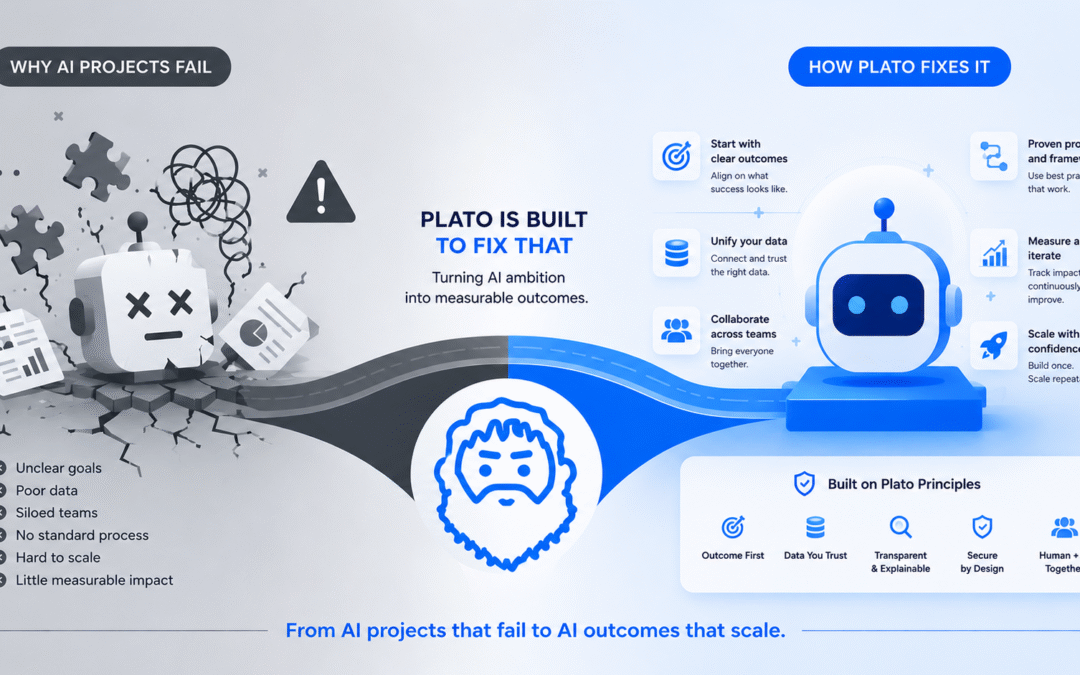
Roughly 80% of AI projects never reach production, and 42% of companies abandoned most AI initiatives in 2025. The root cause is almost never the technology – it is the strategy, planning, and governance that surrounds it. Standard portfolio tools were not built for AI: they miss data readiness, ignore run costs, and treat a RAG implementation identically to a predictive model. Plato is purpose-built to close each of these gaps.
1. Structured Intake: Capture What Actually Predicts Success
THE PROBLEM: Standard intake forms capture budget and description. They miss the attributes that determine whether an AI initiative will succeed or fail.
Informational (portfolio composition):
- AI Initiative Type: Process Automation, RAG, Agentic, Fine-tuned, Vision, Recommendation, Decision Support.
- Data Privacy Sensitivity: No PII through Regulated Health and Multi-category – assessed at intake before data access is assumed.
- Reusability / Platform Value: Foundational Platform through Standalone – surfaces leverage and duplication across the portfolio.
- Benefit Type: Separate frameworks for Internal AI (Hard Dollar, Productivity, Risk Avoidance, Revenue, Strategic Option) and Product AI (Acquisition, Retention, Upsell, Differentiation, Customer Outcome).
Scored (feed the AI Success Index):
- AI / Data Readiness: labeling status, volume, pipeline maturity, and regulatory constraints assessed before funding.
- Organizational Readiness: exec sponsorship, change management maturity, and capability gaps captured and scored.
- Risk Profile, Human-in-the-Loop Design, Dependencies, Build vs. Buy vs. Partner, Model Output Consequence, Failure Pattern Risk: each scored at intake to surface delivery and governance risk before a dollar is committed.
2. The AI Success Index: Score by What Actually Predicts Success
THE PROBLEM: Generic scoring models rank AI initiatives on budget size and strategic alignment – missing the dimensions that determine whether an AI project will survive contact with reality.
Plato’s AI Success Index translates the eight scored intake attributes into a single prioritization score. Criteria and weights are fully customizable by your leadership team.
| Criterion | What It Assesses |
| Organizational Readiness | Is the business ready to adopt and sustain this? |
| AI / Data Readiness | Is the data and infrastructure foundation available? |
| Failure Pattern Risk | How many known failure patterns are present? |
| Model Output Consequence | What happens operationally when the AI is wrong? |
| Risk Profile | Regulatory and compliance exposure level |
| Human-in-the-Loop Design | How much oversight is built into the workflow? |
| Dependencies | Reliance on things that do not exist yet |
| Build vs. Buy vs. Partner | Does the delivery approach match actual capability? |
- Powered by Plato Prism Score: same governance, confidence scoring, justification requirements, and audit trail as all standard ranking methodologies.
- Comparison mode: run alongside Momentum Score or Yield Index to see where financial attractiveness and AI readiness agree – and where they diverge.
3. An AI-Aware Financial Model
THE PROBLEM: Standard financial models capture build costs. AI initiatives have low build costs and high operate costs – and the run cost is almost always underplanned.
- Build costs: infrastructure, internal/external labor, vendor/licensing, and data preparation tracked separately.
- Operate costs: API/inference costs, model maintenance, human oversight staffing, and ongoing data costs – the dominant cost driver for GenAI at scale, and almost always underplanned.
- Internal AI benefit framework: Hard Dollar Savings, Productivity Gain, Risk Avoidance, Quality Improvement, Strategic Option Value.
- Product AI benefit framework: ARR/Customer Acquisition, Churn Reduction, Upsell, Competitive Differentiation, Customer Outcomes, Platform Value.
- Flexible financial models: CapEx/OpEx splits, expense types, and headcount tracked independently; configurable to match your budgeting structure.
4. The AI Portfolio Governance Dashboard
THE PROBLEM: AI portfolios are governed through status meetings and email chains. Leadership has no live view of readiness, risk, or benefit realization across the portfolio.
A live view of the entire AI portfolio – not a PowerPoint assembled the night before a steering committee. Five panels, each addressing a distinct governance need:
- Portfolio summary and composition: total AI budget, average readiness score, benefit realization rate, and a breakdown by initiative type – surfacing concentration risk and portfolio health at a glance.
- Initiative lifecycle tracker: Pilot, Validated, Scaling, and Steady State tracked with stage conversion rates; initiatives stalled more than 90 days flagged by name for immediate action.
- Model risk and readiness: High/Medium/Low risk breakdown with specific flags for bias gaps, missing human-in-the-loop, and pending ethics review; portfolio readiness averages shown against the approval threshold.
- AI Initiative Scorecard: every initiative in a governed table showing Type, Stage, AI Readiness, Model Risk, Data Readiness, Ethics Flag, Benefit Status, Budget, and Rank.
- Governance actions required: live action list – Ethics Review Needed, Data Readiness Below Threshold, Bias Assessment Overdue, Benefit Hypothesis Missing, Awaiting Confidence Review – each with a count and direct link to act.
AI Portfolio Readiness Scorecard
| AI Portfolio Risk | Signs You Are Exposed | How Plato Addresses It |
| No value thesis | Initiatives approved on aspiration with no measurable outcomes, benefit type, or ROI targets | Mandatory benefit type classification and financial fields enforced at submission; benefit commitments tracked across cycles |
| Novelty-driven prioritization | AI projects selected by executive enthusiasm, not structured scoring of readiness and risk | AI Success Index scores all eight success predictors before funding; comparison mode shows every angle before committing |
| Data readiness assumed | Data quality, availability, and regulatory constraints not assessed before funding decisions | AI/Data Readiness scored as a required attribute; low scores surface in ranking before approval |
| Initiative type ignored | RAG, agentic, and predictive initiatives scored identically despite very different risk profiles | AI Initiative Type captured at intake; scoring and financial framework adapt by type |
| Build costs only | Run costs – inference, model maintenance, human oversight – not planned or tracked | Separate build and operate cost frameworks; inference, maintenance, and oversight staffing tracked independently |
| Adoption not planned | Organizational readiness treated as a post-deployment concern | Organizational Readiness scored at intake and weighted at 20% in the AI Success Index |
| No portfolio governance | Internal AI and product AI managed in silos with no cross-portfolio view | Unified portfolio with separate benefit frameworks for internal and product AI; ranking dashboard and audit trail |
The organizations succeeding with AI are not smarter. They are more disciplined. They assess readiness before funding, not after.
Plato is the only portfolio platform that treats AI initiatives as categorically different from standard IT projects – capturing the attributes, applying the scoring, and enforcing the governance that makes AI investment decisions defensible from submission through delivery.
Request a demo at platosoftware.com to see Plato’s AI portfolio management capabilities in action.